
Chandrayaan-3 Quiz: GK Questions and Answers in English





Our editorial process ensures that the information we provide is well-researched and reliable. Learn more about our approach in the FirstCry Parenting editorial policy.
The universe is vast and fascinating, with so much left to explore and understand. One of our closest celestial neighbours, the Moon, has been a source of intrigue and inspiration for centuries. In recent years, India’s space missions have rekindled that interest and expanded our knowledge in giant leaps. Chandrayaan-3 is India’s latest lunar probe, and its endeavors have opened up fresh avenues of learning. If you’re a student looking to test your knowledge or simply a curious soul eager to learn more, you’ve landed at the right spot. We’ve curated some intriguing gk questions on Chandrayaan-3 for students, ensuring that your quest for knowledge remains satiated. Dive into our Chandrayaan-3 gk questions and answers in English and embark on a journey of discovery.
What is the Mission Chandrayaan-3?
Chandrayaan-3 is India’s third lunar exploration mission, built upon the learnings and aspirations of its predecessors. With its primary objective to push the boundaries of lunar research, this mission captures the imagination of space enthusiasts everywhere. As you prepare for a Chandrayaan-3 quiz or engage in a gk quiz on Chandrayaan-3, delving into the essence of this mission will undoubtedly elevate your understanding and appreciation.
Chandrayaan-3 : An Overview
After the partial success of the Chandrayaan-2 mission (where the orbiter successfully entered lunar orbit, but the lander Vikram crash-landed on the moon’s surface), the Indian Space Research Organisation (ISRO) decided to launch another mission, named Chandrayaan-3.
Key Points of the Mission :
1. No Orbiter: Unlike Chandrayaan-2, Chandrayaan-3 is primarily a landing mission. Since the Chandrayaan-2 orbiter is still operational and sending data from lunar orbit, Chandrayaan-3 will not have a separate orbiter. Instead, it will focus on the lander and rover components.
2. Enhanced Lander Design: Learning from the Chandrayaan-2 lander’s unsuccessful soft-landing attempt, ISRO has incorporated significant design changes and improvements for the Chandrayaan-3 lander to ensure a successful landing on the moon’s surface.
3. Mission Objectives: The primary objective is to demonstrate the ability to soft-land on the lunar surface and operate a robotic rover on the moon. This rover will conduct experiments, collect data, and relay it back to Earth, providing valuable insights into the moon’s geology, composition, and other attributes.
4. Collaborations: There’s been discussion about international collaboration for some instruments and technology, although ISRO would be at the forefront of the mission’s execution.
5. Launch Timeline: Chandrayaan-3 has started its voyage to the Moon on its designated trajectory. The spacecraft is in good condition. A 24-hour ‘Launch Rehearsal’, which mimics the full launch procedure, has been successfully completed. The lift-off is set for July 14, 2023, at 14:35 Hrs.
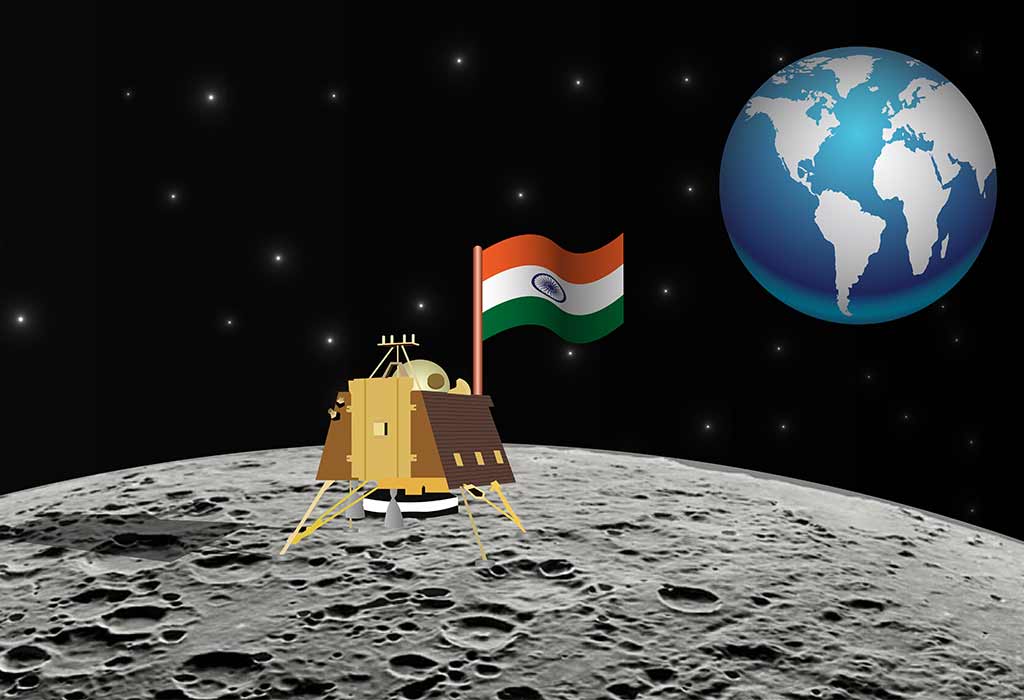
6. Location: On August 23, 2023, the Chandrayaan-3, under the auspices of ISRO (Indian Space Research Organization), made its landing on the Moon. The landing zone is roughly 600 kilometres away from the Moon’s South Pole. Four days post-landing, the LROC (LRO Camera) captured a slanted image (at a 42-degree angle) of the lander. The noticeable bright circle surrounding the lander was caused by the rocket’s exhaust interacting with the Moon’s fine soil, known as regolith.
Chandrayaan-3, like its predecessors, is a testament to India’s growing capabilities and ambitions in space exploration. It aims to build on the successes and learnings of the past missions to advance our understanding of our closest celestial neighbor.
Also Read: Essay on Chandrayaan-3 in English
50 Gk Questions with Answers On Chandrayaan-3
Dive deep into the details of Chandrayaan-3, India’s ambitious lunar exploration mission. To help you test your knowledge, we’ve assembled a list of 50 thought-provoking questions about the mission. Whether you’re a space enthusiast, a student, or someone simply looking to learn, these questions and their detailed answers will ensure you’re well-informed about Chandrayaan-3.
1. What is the primary objective of the Chandrayaan-3 mission?
a) To orbit Mars
b) To soft-land on the Moon’s south pole
c) To orbit the Moon
d) To explore the dark side of the Moon
2. Which organization is spearheading the Chandrayaan-3 mission?
a) NASA
b) ESA (European Space Agency)
c) SpaceX
d) ISRO (Indian Space Research Organisation)
3. Chandrayaan-3 is a direct successor to which mission?
a) Mars Orbiter Mission
b) Chandrayaan-1
c) Chandrayaan-2
d) Aditya-L1
4. Unlike Chandrayaan-2, what is notably absent in Chandrayaan-3’s components?
a) Rover
b) Lander
c) Satellite
d) Orbiter
5. Which region of the Moon is Chandrayaan-3 expected to explore?
a) Equatorial Region
b) North Pole
c) Far Side
d) South Pole
6. What is the name of the lander for the Chandrayaan-3 mission?
a) Pragyan
b) Aryabhata
c) Vikram 2
d) Brahma
7. How many wheels does the anticipated rover in the Chandrayaan-3 mission have?
a) Four
b) Six
c) Eight
d) Two
8. What is the anticipated life of the Chandrayaan-3 rover once it lands on the Moon?
a) One week
b) 14 Earth days
c) One Earth month
d) 365 Earth days
9. The word “Chandrayaan” is derived from which language?
a) Hindi
b) Sanskrit
c) Telugu
d) Tamil
10. Chandrayaan-3’s landing site is expected to be in proximity to which landmark on the Moon?
a) Sea of Tranquility
b) Tycho Crater
c) Aitken Basin
d) Apollo 11 landing site
11. Which component of Chandrayaan-2 failed to land successfully on the Moon?
a) Pragyan
b) Aryabhata
c) Vikram
d) Surya
12. Which element, speculated to be present on the Moon, could be a potential fuel for future nuclear fusion?
a) Uranium
b) Plutonium
c) Helium-3
d) Thorium
13. In the context of space missions, what does the term ‘soft landing’ mean?
a) Landing on a soft surface
b) Landing without any technical support
c) A controlled landing without damage to the spacecraft
d) Landing using parachutes
14. Which space agency is working on the Artemis program to return humans to the Moon?
a) ESA
b) Roscosmos
c) NASA
d) CNSA
15. What role does ISRO’s “Deep Space Network” play in the Chandrayaan missions?
a) Launching the spacecraft
b) Housing the astronauts
c) Communicating with the spacecraft
d) Manufacturing spacecraft components
16. In which Indian state is the primary launch site for ISRO’s space missions located?
a) Maharashtra
b) Karnataka
c) Andhra Pradesh
d) Kerala
17. The discovery of what on the Moon’s poles has sparked interest in potential lunar colonization?
a) Gold
b) Water ice
c) Rare Earth metals
d) Helium
18. Chandrayaan-3’s launch vehicle is expected to be which one of the following?
a) LVM3 M4
b) GSLV Mk III
c) GSLV Mk II
d) RLV-TD
19. Which of the following is a primary scientific instrument on the Chandrayaan-3 rover?
a) Solar sail
b) Lunar dust analyzer
c) Deep space antenna
d) Alpha Particle X-Ray Spectrometer (APXS)
20. What is the expected weight of the Chandrayaan-3 lander?
a) 500 kg
b) 1,700 kg
c) 800 kg
d) 1,450 kg
21.Which of these is a significant challenge faced by lunar rovers?
a) Intense gravity
b) Lunar night’s extreme cold
c) High atmospheric pressure
d) Strong winds
22. Which previous Chandrayaan mission involved an impact probe?
a) Chandrayaan-1
b)Chandrayaan-2
c) Both
d) None
23. Why is the presence of water on the Moon significant?
a) It’s good for tourism
b) It indicates the Moon has an atmosphere
c) It can be a potential resource for future lunar missions and habitation
d) It’s necessary for the Moon’s magnetic field
24. How long does it take for a spacecraft to travel from Earth to the Moon, on average?
a) 3 hours
b) 3 days
c) 30 days
d) 300 days
25. What is ISRO’s planned manned mission to space called?
a) Vayunaan
b) Gaganyaan
c) Antarikshyaan
d) Bhuvanaan
Answers
Q1. Ans. (b) To soft-land on the Moon’s south pole
While the Chandrayaan-3 mission has several objectives, its primary goal is to demonstrate the ability to soft-land on the lunar surface. The mission focuses on landing and operating a robotic rover on the moon, especially since the Chandrayaan-2 orbiter is still functional and transmitting data.
Q2. Ans. (d) ISRO (Indian Space Research Organisation)
The Chandrayaan-3 mission is an initiative of the Indian Space Research Organisation (ISRO). ISRO is India’s national space agency and has been at the forefront of the country’s space exploration efforts, including the Chandrayaan series of lunar missions.
Q3. Ans. (c) Chandrayaan-2
Chandrayaan-3 is the follow-up mission to Chandrayaan-2, aimed at accomplishing a successful soft landing on the Moon after the Chandrayaan-2 lander faced challenges during its landing attempt.
Q4. Ans. (d) Orbiter
Chandrayaan-3 does not include an orbiter because the Chandrayaan-2 orbiter is still operational and transmitting valuable data from lunar orbit.
Q5. Ans. (d) South Pole
Chandrayaan-3’s anticipated landing region is near the Moon’s south pole, which holds significant interest due to the presence of water ice and unique environmental conditions.
Q6. Ans. (c) Vikram 2
While specific details might change as the mission gets closer to its launch date, as of the latest information, the successor to the Vikram lander (Chandrayaan-2) is often colloquially referred to as “Vikram 2”.
Q7. Ans. (b) Six
The rover for the Chandrayaan-3 mission, similar to its predecessor in Chandrayaan-2, is designed to have six wheels for optimal mobility on the lunar surface.
Q8. Ans. (b) 14 Earth days
The Chandrayaan-3 rover, like its predecessor from Chandrayaan-2, is expected to have a mission life of approximately 14 Earth days, which is roughly equivalent to one lunar day.
Q9. Ans. (b) Sanskrit
The word “Chandrayaan” comes from Sanskrit, where “Chandra” means “Moon” and “Yaan” means “Vehicle” or “Craft”.
Q10. Ans. (c) Aitken Basin
The South Pole-Aitken Basin is of great interest due to its unique geology and the potential presence of water ice. Chandrayaan-3 is expected to explore this region.
Q11. Ans. (c) Vikram
Vikram was the lander component of Chandrayaan-2. It unfortunately crash-landed on the Moon’s surface in September 2019.
Q12. Ans. (c) Helium-3
Helium-3, an isotope of helium, is believed to be abundant on the Moon and is considered a potential fuel for future nuclear fusion power.
Q13. Ans. (c) A controlled landing without damage to the spacecraft
A ‘soft landing’ refers to a controlled descent and landing, ensuring the spacecraft lands without any damage, enabling it to carry out its intended mission on the surface.
Q14. Ans. (c) NASA
NASA’s Artemis program aims to land “the first woman and the next man” on the Moon by the mid-2020s and establish a sustainable human presence on the Moon by the end of the decade.
Q15. Ans. (c) Communicating with the spacecraft
ISRO’s Deep Space Network (DSN) plays a pivotal role in tracking and communicating with distant spacecraft, including the Chandrayaan missions.
Q16. Ans. (c) Andhra Pradesh
The primary launch site for ISRO’s space missions, the Satish Dhawan Space Centre (also known as Sriharikota Range), is located in Andhra Pradesh.
Q17. Ans. (b) Water ice
The discovery of water ice, particularly on the Moon’s south pole, is significant for potential lunar colonization. Water is essential for life and can also be used for rocket fuel.
Q18. Ans. (a) LVM3 M4
The LVM3 M4 launcher has been selected for the Chandrayaan-3 mission, and it’s designed to position the combined module into an Elliptic Parking Orbit (EPO) with dimensions of approximately 170 x 36500 km. The primary goal of Chandrayaan-3 is to showcase a secure and gentle touchdown on the Moon’s surface.
Q19. Ans. (d) Alpha Particle X-Ray Spectrometer (APXS)
The alpha particle X-ray spectrometer (APXS) is designed to ascertain the chemical makeup and deduce the mineralogy of the Moon’s surface. Meanwhile, using laser-induced breakdown spectroscopy (LIBS), the elemental constituents (including Mg, Al, Si, K, Ca, Ti, Fe) of lunar soil and surrounding rocks at the landing site will be identified.
Q20. Ans. (b) 1,700 kg
The Chandrayaan-3 lander is approximately 2 meters in height and weighs slightly more than 1,700 kg (3,747.86 lb), making it comparable to the weight of an SUV. Its design includes the capability to release a 26-kg moon rover.
Q21. Ans. (b) Lunar night’s extreme cold
Lunar nights can be brutally cold, dropping temperatures to about -180°C. This extreme cold poses a challenge for rovers and their instruments.
Q22. Ans. (a) Chandrayaan-1
Chandrayaan-1 involved an impact probe that was deliberately crashed onto the lunar surface, helping to confirm the presence of water/hydroxyl on the Moon.
Q23. Ans. (c) It can be a potential resource for future lunar missions and habitation
Water is crucial for supporting life, and its presence on the Moon can be a game-changer for future manned missions, providing drinking water and potentially being converted to oxygen for breathing and hydrogen for rocket fuel.
Q24. Ans. (b) 3 days
On average, most lunar missions, including the Apollo and Chandrayaan missions, take about 3 days to travel from Earth to the Moon.
Q25. Ans. (b) Gaganyaan
Gaganyaan is ISRO’s ambitious project to send Indian astronauts, called vyomanauts, to space.
Exploring the mysteries of the Moon through missions like Chandrayaan-3 offers invaluable insights into our celestial neighbor and our own planet’s history. As ISRO continues to push the boundaries of space exploration, such endeavors not only enhance our scientific understanding but also inspire generations to dream big. By delving into these questions, we hope you’ve deepened your appreciation for the wonders of lunar exploration and the advancements in space technology.
Also Read:
Chandrayaan 3 MahaQuiz for Students
Essay On Aditya L1 for Children and Students
Interesting Facts About Space for Children
Was This Article Helpful?
- Author